

 Entrant
 Student
 Graduate
 Employee
 Courses
 Business partner


A boring book that has become a classic for engineers changing their thinking
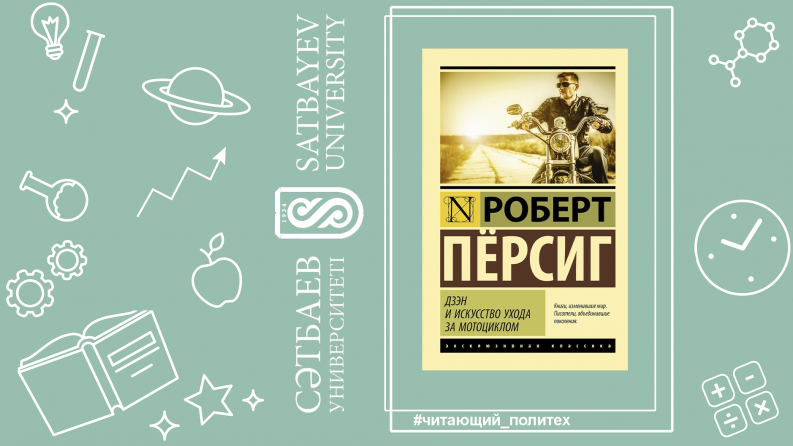
"Zen and the art of motorcycle maintenance" novel by Robert Pirssig is a journey story that not everyone is ready for the first time. For half a century, it has become a cult book among engineers and technology entrepreneurs, raising the main question for technology - what counts as quality and why create it at all. This is a book after which the phrase "I'm just an engineer" ceases to sound convincing.
Technically, this is a road novel: the author and his fifteen-year-old son Chris are riding a motorcycle across America. But pretty quickly, history becomes just a framework for thinking about reasoning, knowledge, and the nature of quality. Get ready for the fact that you will have to read slowly: the novel was published in 1974, in an era when the plot was not yet the only pillar of the text, and literature itself allowed for more philosophical reasoning and descriptions.
At the center of Pirssig's reflections is the concept of "zen", taken from Eastern Buddhist practices, where it is understood as a direct, intuitive experience of reality, bypassing consciousness. This raises the main question of the book: what makes a thing "good"? Why does one decision feel right, even if technically everything meets the requirements, and the other does not? Pirssig takes this issue to the engineering plane and shows that quality cannot be fully formalized, but it can be recognized in experience. Just like traveling on a motorcycle, it does not come down to the route or the technical condition of the car, but arises from the interaction of a person and a process.
Through the metaphor of motorcycle maintenance, he talks about a more general principle: technical work is not only a set of operations, but also a form of attitude to reality. The mechanical execution of actions without attention and involvement leads to a mediocre result. But when a person is involved, attentive to details and understands exactly what they are doing, quality appears.
In the context of technical education, the book sounds particularly accurate. Pirssig criticizes the division of knowledge into "exact" and "humanitarian", arguing that such a division impoverishes both sides: engineers - depriving philosophical depth, humanities - understanding technology. According to his logic, a holistic perception of the world is necessary for any truly strong engineering work.
This book is not easy. It takes time, patience, and a willingness to think slowly. But maybe that's why it became an unexpected intellectual bestseller: more than 5 million copies have been sold to date, and this novel is still being read by people working with technology. This is its paradox: this is not a textbook or a classic novel, but a thinking experience that does not explain how to think properly, but gradually changes the way we perceive work, quality, and the creation process.