
 Entrant
 Student
 Graduate
 Employee
 Courses
 Business partner


Hermeneutic approach and Bildung in action as a framework for SDGs: the second semester of ArtLab is being implemented at Satbayev University
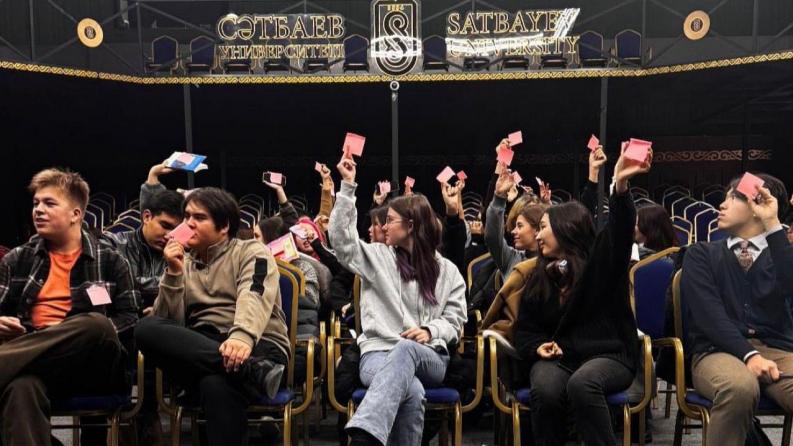
The second semester of the Cycle of creative disciplines program by ArtLab is currently actively underway at Satbayev University. More than 100 students are already engaged in project work and are developing interdisciplinary solutions based on real social and professional challenges.
The program is built on the principles of the hermeneutic approach to education, where learning is understood as a process of interpretation, dialogue, and meaning-making. Students construct their own understanding through practice and interaction, acting as active participants in the educational process.
Conceptually, the program is grounded in the tradition of Bildung, which is oriented toward the development of personality, critical thinking, and the capacity for self-determination. In the context of a technical university, this enables the preparation of specialists capable of working with uncertainty, communication, and complex social challenges.
In the first semester, students mastered key art disciplines and сформировали a “problem cloud” — a map of актуальных challenges. Based on this, in the second semester, 10 interdisciplinary projects have been launched, aimed at developing solutions in line with the Sustainable Development Goals (SDGs), including areas such as urban environment, inclusion, ecology, and educational technologies.
“We chose the hermeneutic approach and the tradition of Bildung as the foundation of the program because it is important for us to develop the ability to understand. The ‘problem cloud’ captures how students see the world, and project work becomes a process of interpreting these problems and transforming them into solutions. As a result, students learn not only how to solve problems, but also how to formulate them correctly,” — Anel Syzdykova-Bitossi, head of the Cycle of creative disciplines and ArtLab.
The final stage will be a public presentation of the projects, where teams will present their results and prototypes. Thus, the second semester marks the transition to practical implementation, in which ArtLab acts as a space for the integration of science, art, and technology.