
 Entrant
 Student
 Graduate
 Employee
 Courses
 Business partner


Scientists from Satbayev University and Ghent University have outlined areas of cooperation in AI and geo-analytics field
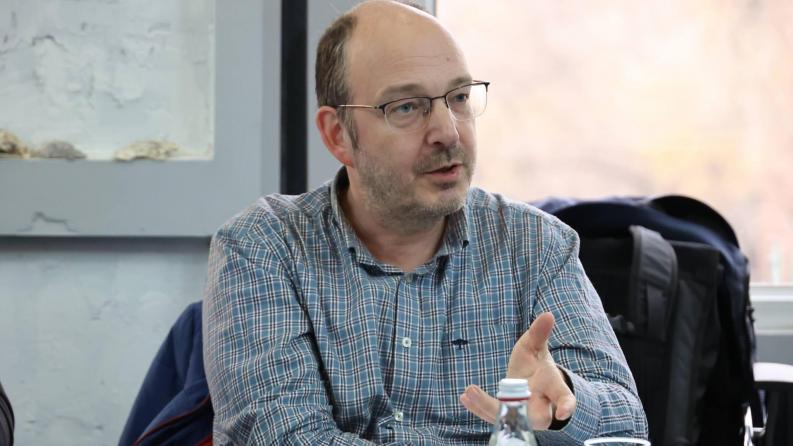
Satbayev University scientists held a working meeting with Ghent University representatives, discussing the prospects for cooperation in the field of artificial intelligence, statistics and geo-information technologies. On the part of Satbayev University, the meeting was attended by professors and researchers from Automation and Information Technology Institute, as well as scientists from Chemical and Biochemical Engineering Department. Ghent University delegation was led by one of University's leading scientists, professor Eric Mannens.
Ghent University is one of the largest and leading research universities in Europe, located in Ghent, Belgium. Founded in 1817, University is consistently ranked in the top 100 worldwide due to its high scientific productivity, strong engineering and technical school and a wide range of programs in natural sciences, biotechnology, medicine, humanities and IT sphere.
University is known for its research in the fields of artificial intelligence, bioengineering, sustainable development, agricultural technologies, statistics, geo-information systems and materials science. Ghent University is actively developing international campuses and partnerships, including its new campus in South Korea, where it conducts research in the biosciences and computational statistics field.
Both universities have broad competencies in the field of IT and artificial intelligence, and are ready to start cooperation in the given field. Of particular interest were the areas of Sustainable AI, statistical modeling and GeoAI, in which Belgian scientists are traditionally leaders. The parties also discussed the possibilities of academic mobility and evolving the degree programs in the areas of Sustainable AI, GeoAI and other IT areas. An initiative was proposed for a double degree program at PhD level, based on Ghent University's experience with other universities. The meeting was an important step towards forming a long-term partnership that opens up new horizons for joint research and training of highly qualified specialists.