
 Entrant
 Student
 Graduate
 Employee
 Courses
 Business partner


By the way, about the session: Scott Yang's Super-learning strategy
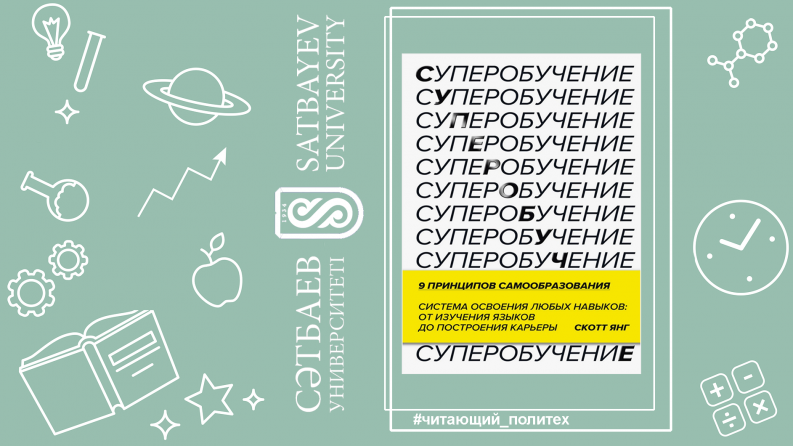
Self-education and lifelong learning are a reality even for those who go to university every day. Almost every student has dreamed at least once of studying for exams faster, memorizing more, and not spending endless nights cramming. Understand the material the first time, concentrate and spend less time studying, while getting better results. This is exactly what Scott Young’s “Super learning” book teaches – a practical and modern manifesto of independent education.
The book is based on Scott's own experience as a Canadian podcaster, writer, and blogger who loves to do strange experiments on himself. Before writing "Super Learning" book, he decided on such an experiment: to master the four-year bachelor's degree program in computer science at MIT in a year. Spoiler alert: he went through the whole program. The experiment was called the MIT Challenge and is still available on Scott's website. Later, he learned three languages in a comparable amount of time using the same method. He outlined the results in the book.
Unlike inspiring but abstract texts about the potential of the brain, Yang offers a specific strategy: how to master complex skills quickly, deeply, and without formal training. Yang formulates nine principles of "ultra-learning," including meta-learning (first understanding exactly how to learn), concentration, practice, active reproduction instead of passive rereading, working on weaknesses, and systemic feedback. Thanks to this method, anyone can learn almost anything very quickly.
The book's strong point is its pragmatism. The author emphasizes that information is truly assimilated only when a person begins to interact with it - to pronounce, apply, explain to others, use in a dialogue or game. This is not about watching courses, but creating your own projects and testing yourself in real conditions. The idea of purposeful practice is particularly useful. Instead of repeating it, Yang suggests looking for the weakest points and working with them. It's a familiar situation: one formula or one principle can block the understanding of an entire topic. When such knots are untangled, the rest of the knowledge system begins to take shape much faster.
The given approach is surprisingly consistent with the reality of university life. Students constantly find themselves in a situation where there is too much material and too little time: several courses at the same time, laboratory, deadlines, exam preparation. In these circumstances, familiar strategies often stop working.
"Super learning" does not promise easy paths and instant results. But the book shows that even with a busy academic schedule, you can learn much more effectively if you treat learning as an active process. This is especially important for students of a technical university: complex disciplines require not only time, but also the right strategy for working with knowledge. And perhaps the most useful skill of a student is not to take notes on lectures, but to turn learning into their own experiment.
For information on how to turn learning into a system, rather than fighting deadlines, read Scott Young's "Super learning" book.