

 Entrant
 Student
 Graduate
 Employee
 Courses
 Business partner


Richard Feynman presents curiosity as an engineering thinking skill
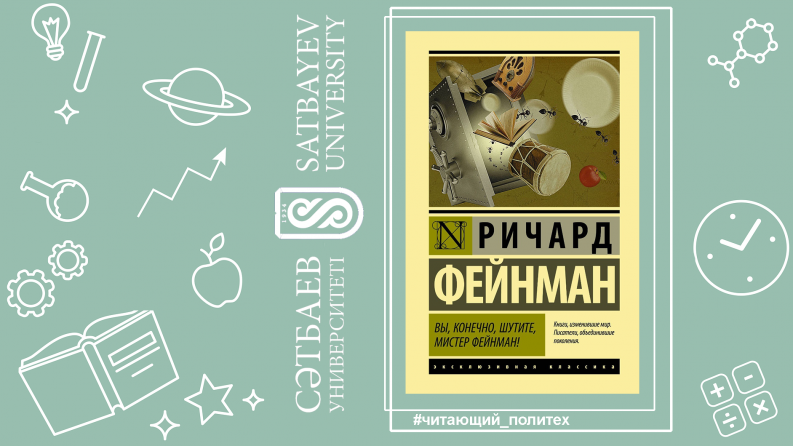
Developing an attitude towards knowledge is one of the key challenges of technical education. Today, Satbayev University is launching a new initiative dedicated to the culture of reading. Read book reviews on the website that will help you discover books that change the way you look at the world.
Richard Feynman, "You must be joking, Mr. Feynman!"
Richard Feynman (1918 -1988) was a famous Nobel Prize-winning physicist. One of the creators of quantum electrodynamics and the atomic bomb, the inventor of diagrams describing the interactions of subatomic particles in the framework of quantum field theory. Three years before his death, he created and published the most popular book about physicists, "You Must be Kidding, Mr. Feynman!" in which he talked about his life, his high school antics, and scientific ways to meet girls.
The book was published in 1985 and immediately became a cult, including far beyond the scientific community. Feynman talks about his life not as the "path of a great scientist," but as a chain of curious and sometimes absurd situations. He writes about his childhood, working on the Manhattan Project, traveling, playing bongos, cracking safes, and experimenting with his own thinking. Almost every story begins as an anecdote, but ends with an unexpected observation about how people, science, or ideas work.
One of the main themes of the book is radical curiosity. Feynman is constantly testing the world "by touch": it is important for him to understand how and why something works, and not just accept an authoritative explanation. He easily violates social rules if they interfere with honest thinking, and is not afraid to look strange or naive.
He easily walks into a bar, gestures for a glass of milk, as if he were deaf and dumb, drinks in silence, and then says, "Thank you!" He steals and hides the door from his classmate's room, and then honestly declares it (but they don't believe him). He checks the causes of “Challenger” disaster with pliers and a glass of ice. The result is brilliant technical ideas.
The second important idea is to be honest with yourself. Feynman repeatedly emphasizes that it is easiest for a person to deceive themselves. This applies both to science and to everyday life. His book reads like a blog of a man who lives ahead of the times: he tests boundaries, breaks rules, enjoys life, learns to draw, goes to Japan, and asks questions. Therefore, physicists, humanities scholars, entrepreneurs and students read it with equal pleasure.
If you are tired of books that explain the world too confidently, Feynman will be an excellent antidote.