
 Entrant
 Student
 Graduate
 Employee
 Courses
 Business partner


Satbayev University Introduces the IMPACT Program and Explores New Pathways for Engineering Workforce Development
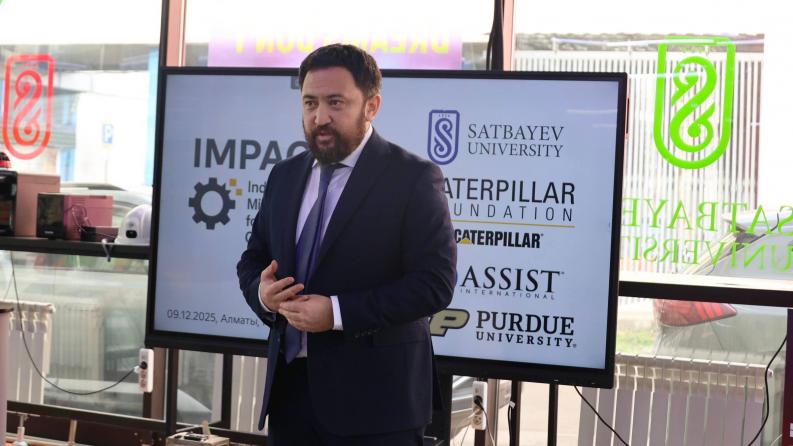
Satbayev University hosted a presentation on the IMPACT project (Industry-aligned Minor Programs for Applied Career Training), featuring industrial companies and international collaborators, including the Caterpillar Foundation, Assist International, BorusanCAT, and Purdue University. During the event, the university introduced its hands-on practice-oriented engineering training program for CNC machine operators. The main objective of the program is to equip students with the tools, skills, and confidence required to transition from academic learning to real industrial production.
Dr. Ruslan Mukanov, Associate Professor at Satbayev University and the lead for IMPACT, emphasized that financial support from the Caterpillar Foundation and partnership with Assist Internation, along with their expertise and continuous feedback, have been key elements in the successful launch of IMPACT. Participants also discussed the university’s collaboration with Purdue University, whose experts are helping integrate advanced manufacturing training standards and develop joint courses based on American educational models.
The strategic importance of the project received high recognition from the Caterpillar Foundation’s community ambassador for Kazakhstan, Zhanna Abdrakhmanova, who noted:
“We started this work almost six months ago, and today we are already seeing its first results: the infrastructure has been upgraded, and the IMPACT program has been launched. On behalf of the Caterpillar Foundation, it is important for us to support initiatives that provide young specialists with practical skills and real access to the best-in-class global technologies.”
Assist International Program Manager Trevor Cook highlighted the results of the two-year collaboration between Satbayev University, Purdue University, and international organizations.
In his remarks, he stated:
“Almost two years ago, we began discussions with Dr. Mukanov about what such a project could become—how the partnership between Satbayev University and Purdue University could strengthen academic programs, improve the quality of technical training, and provide students with industry-ready skills from day one. Today, it is especially rewarding to see early planning turn into reality, with students already engaged in training and benefiting from the new educational pathways.
And of course, all of this has become possible thanks to the generous support of the Caterpillar Foundation — both through its funding as well as its deep involvement in the program’s development.”
During the discussion, participants highlighted the need to better align academic training with industry demands. The IMPACT initiative addresses this gap by offering three micro‑qualifications — Digital Design Engineer, Reverse Engineering Design Engineer, and CNC Machine Operator — that give students hands‑on, industry‑verified skills in areas such as SolidWorks, 3D scanning, additive manufacturing, and CNC programming.
Integrated into university programs, these micro‑qualifications enable students to gain their first professional competencies as early as their second year.
With IMPACT, Satbayev University is strengthening its role as a regional technical hub and taking a major step toward modernizing engineering education through innovation and global collaboration.
Each micro-qualification is structured to ensure intensive engagement with modern technologies. University representatives noted that the micro-qualifications are fully integrated into academic programs and that their format aligns with industry needs, as practical skills are becoming increasingly decisive.
Satbayev University aims to strengthen its position as a leading regional technical hub by improving infrastructure and expanding international cooperation. The university leadership expressed gratitude to faculty, students, and partners for their involvement in the project, noting that the launch of IMPACT is only the beginning of an important long-term effort to modernize engineering education.